> For the complete documentation index, see [llms.txt](https://docs.cakewallet.com/llms.txt). Markdown versions of documentation pages are available by appending `.md` to page URLs; this page is available as [Markdown](https://docs.cakewallet.com/tutorials/prove-a-monero-payment.md).
# Prove a Monero payment
Sometimes you need to **prove that you sent a Monero payment** — for example, to show a merchant or exchange that your transaction really reached their address. Because Monero is private, a payment can't be checked from the blockchain alone, but Monero gives you a way to prove a specific payment to a specific recipient.
Cake Wallet shows you everything you need, and Cake's own [Monero block explorer](https://explorer.monero.com/) can verify it.
{% hint style="info" %}
You'll share three things with whoever needs to verify the payment: the **transaction ID**, the **recipient's address**, and the **secret transaction key**. The transaction key only reveals this one payment — it does **not** give access to your wallet or funds.
{% endhint %}
{% hint style="warning" %}
**Before you start: two things have to already be true.** The transaction key and the recipient address are **not** stored on the blockchain. They are saved only on the device that sent the payment, at the moment you sent it, so they cannot be recovered afterwards.
* **"Save recipient address" must have been on when you sent.** The **Recipient addresses** row only appears when the privacy setting `Save recipient address` (gear icon → `Wallet settings` → `Privacy`) was enabled at the time the transaction was sent. This setting is **on by default**, but if you have switched it off you will not be able to prove payments.
* **A restored or rescanned wallet won't have these values.** Because both are stored locally, a wallet restored from your seed on another device has no saved transaction keys or recipient addresses. A [rescan](https://docs.cakewallet.com/features/managing-your-wallet/rescan) also clears them — see [Why are my funds not appearing?](https://docs.cakewallet.com/faq/funds-not-appearing)
If either applies, the rows below will be missing or empty, and this payment can no longer be proven this way.
{% endhint %}
## Find the details in Cake Wallet
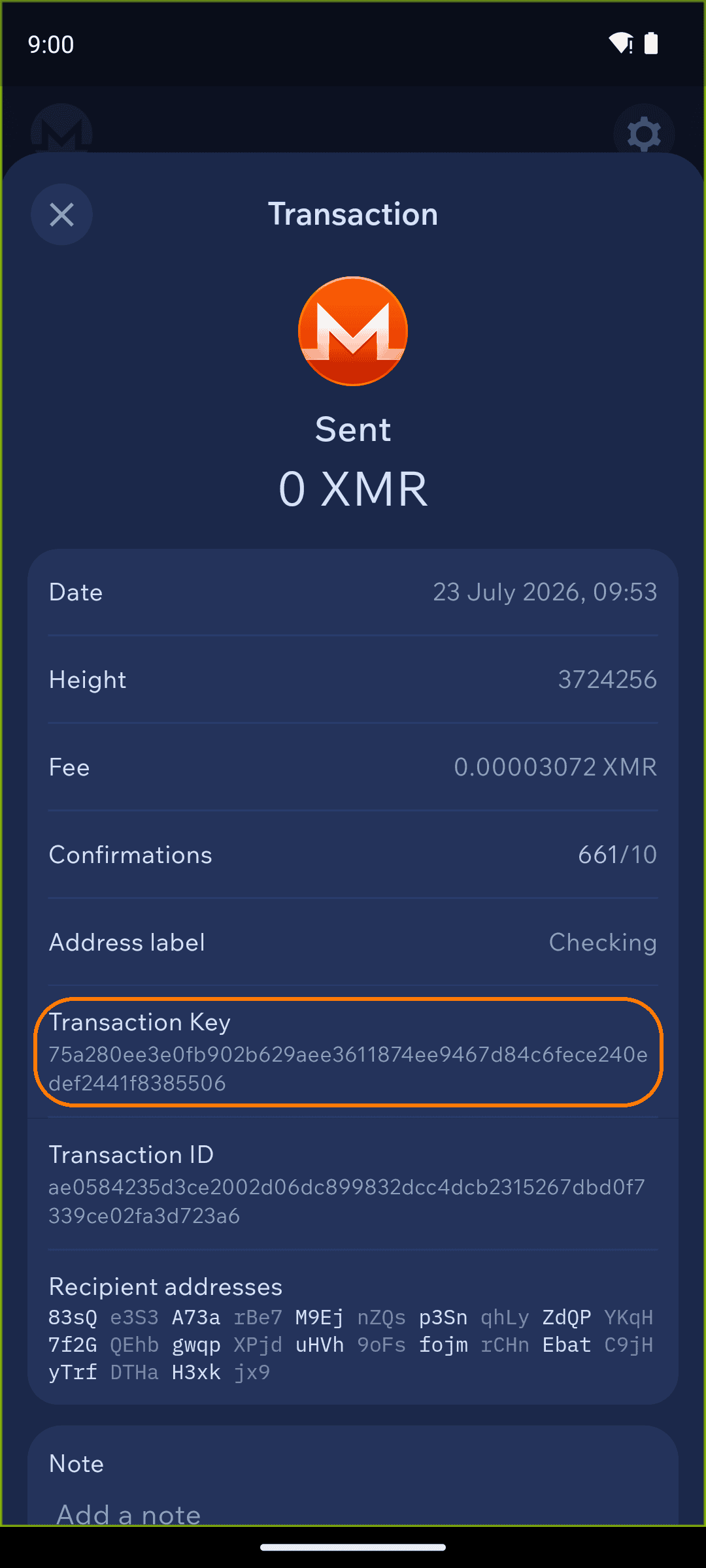
Open your Monero wallet and tap the sent transaction in your history to open its details. You'll need three values from this screen:
* **Transaction ID**
* **Recipient address** (under "Recipient addresses")
* **Transaction Key**
Tap any value to copy it.
## Verify on the Monero explorer
Go to [explorer.monero.com](https://explorer.monero.com/) and choose **"I sent Monero."** On the **Get a transaction receipt** page, fill in:
1. **Transaction ID**
2. **Recipient address**
3. **Secret transaction key** — this is the **Transaction Key** from Cake Wallet
Then tap **Get receipt**. The explorer confirms the amount that was sent to that address in that transaction — a receipt you can share as proof of payment.
{% hint style="warning" %}
Only share the transaction key with people you want to be able to see this payment. Anyone with these three values can see the amount you sent to that address (but nothing else about your wallet).
{% endhint %}
The explorer also has an **"I received Monero"** option for proving a payment you received — choose it instead and follow the on-screen prompts.
---
# Agent Instructions
This documentation is published with GitBook. GitBook is the documentation platform designed so that both humans and AI agents can read, navigate, and reason over technical content effectively. Learn more at gitbook.com.
## Querying This Documentation
If you need additional information that is not directly available in this page, you can query the documentation dynamically by asking a question.
Perform an HTTP GET request on the current page URL with the `ask` query parameter, and the optional `goal` query parameter:
```
GET https://docs.cakewallet.com/tutorials/prove-a-monero-payment.md?ask=&goal=
```
`ask` is the immediate question: it should be specific, self-contained, and written in natural language.
`goal` is optional and describes the broader end goal you are ultimately trying to accomplish on behalf of the user. GitBook uses it to tailor the answer towards what is most useful for that goal.
The response will contain a direct answer to the question and relevant excerpts and sources from the documentation.
Use this mechanism when the answer is not explicitly present in the current page, you need clarification or additional context, or you want to retrieve related documentation sections.